Dispatch Flow
The Orchestrator is the "brain" of the session. It translates a vague user request into a deterministic set of tasks, ensuring no step is skipped and every agent has exactly the context it needs.
🔄 The Dispatch Pipeline
Neuralgentics does not use simple linear prompts. It uses a decompositional pipeline.
View as PNG (better for some renderers)
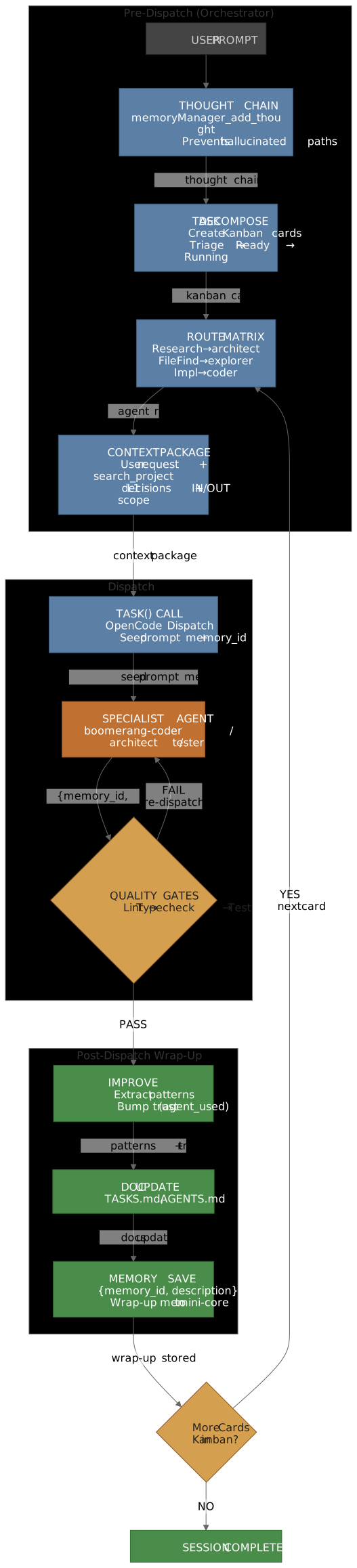
Diagram 3 — Dispatch Pipeline. A user prompt flows through three lifecycle phases — pre-dispatch (orchestrator's thinking: thought chain → task decomposition → routing → context package), the dispatch itself (
task()call → specialist agent → quality gates), and post-dispatch wrap-up (IMPROVE pattern extraction → doc update → memory save). If the kanban has more cards, the loop continues; otherwise the session is complete. Every edge is labeled with the data being passed (memory IDs, context packages, wrap-up handles).
Source: diagrams/diagram-3-dispatch-flow.mmd — edit the .mmd and re-run npx mmdc -i ... -o ... to regenerate.
🛠️ Process Details
1. Thought Chain
Before acting, the orchestrator must "think." It uses memoryManager_add_thought to record its reasoning. This prevents "hallucinated paths" and allows developers to audit why a specific agent was chosen for a task.
2. Task Decomposition
The orchestrator transforms a prompt into a list of tasks in TASKS.md. - Triage: Initial sorting. - Ready: Tasks deemed actionable. - Running: The currently executing task.
3. The Routing Matrix
The routing matrix is a hard-coded rule set that prevents agent misuse. For example: - Research $\rightarrow$ boomerang-architect (NOT explorer) - File Finding $\rightarrow$ boomerang-explorer (ONLY glob/find) - Implementation $\rightarrow$ boomerang-coder
4. The Context Package
To stay token-efficient, the orchestrator does not send a dump of all project files. It constructs a Context Package containing: - The specific User Request. - Relevant file snippets via memoryManager_search_project. - Previous decisions from L1 memory. - Defined boundaries (what is IN vs OUT of scope).