System Overview
The Harness
neuralgentics is the harness that turns a language model into a reliable agent. The harness consists of: the broker (tool permission enforcement), the memory engine (trust-scored persistence), the kanban (work decomposition), and the protocol (8-step mandatory lifecycle).
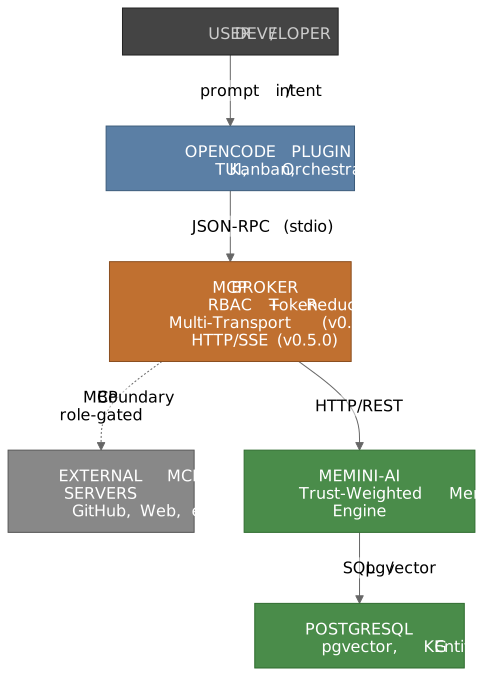
Neuralgentics is not a single application, but a coordinated runtime of three primary layers: the Interface (OpenCode), the Gatekeeper (Broker), and the Brain (Memini-AI).
🏗️ High-Level Architecture
View as PNG (better for some renderers)
Diagram 1 — System Architecture. The flow travels from the User through the OpenCode plugin. The Orchestrator manages the session logic, while the MCP Broker acts as a security and token-reduction gate for all external tool calls. The Memini-AI server handles the semantic "long-term" memory, backed by a vector-enabled PostgreSQL database.
Source: diagrams/diagram-1-overview.mmd — edit the .mmd and re-run npx mmdc -i ... -o ... to regenerate.
🧩 Component breakdown
1. The Interface (OpenCode Plugin)
The plugin integrates Neuralgentics into the IDE. Its primary responsibility is Orchestration. It decomposes user prompts into a graph of tasks and assigns them to specific agents using a routing matrix.
2. The Broker (Go Backend)
The Broker is the most critical security component. It implements Role-Based Access Control (RBAC). - Token Reduction: Instead of sending a 100-tool catalog to every agent, the Broker filters the catalog based on the agent's role. - Intent Matching: Uses Jaccard similarity to map agent intents to the most relevant tools.
v0.4.0 — Multi-Transport & Catalog
The Broker now supports a multi-transport abstraction, allowing MCP servers to declare multiple launch options (e.g., npx, uvx, local binary, docker, http) with automatic fallback chains. To simplify onboarding, the Broker ships with a curated catalog of 20 popular MCP servers embedded in the binary. Additionally, the system now supports runtime LLM provider switching between Ollama Cloud, Docker Model Runner (DMR), and OpenRouter.
v0.5.0 — HTTP Transport & Profile Sharing
v0.5.0 extends the transport abstraction to include HTTP and SSE for hosted MCPs (Cloudflare, Anthropic-hosted, etc.) — the new HTTPClient implements JSON-RPC over HTTP POST with optional Server-Sent Events for streaming responses. The Broker also gains a profile export/import subsystem: users can capture their active set (provider, MCPs, permissions, opencode snapshot) into a portable tar.gz file with optional HMAC-SHA256 signing, then re-apply on another machine. The TUI /profile command handles the round-trip. OCI registry push/pull is deferred to v0.5.1; v0.5.0 ships the tar.gz format only.
3. The Brain (Memini-AI)
Memini-AI is a semantic memory server. Unlike standard RAG, it uses a Trust Engine: - Every memory begins with a trust score of $0.5$. - Successful tool usage increases trust ($+0.05$). - User corrections decrease trust ($-0.10$). - This allows the orchestrator to prioritize "highly trusted" patterns over noisy ones.
🛠️ Tech Stack
| Component | Language | Key Technologies |
|---|---|---|
| Backend/Broker | Go | JSON-RPC, stdio, pgvector |
| Memory Server | Python | FastAPI, pgvector, Sentence-Transformers |
| UI Overlay | TypeScript | OpenCode Plugin API, React |
| Database | SQL | PostgreSQL 16+ |